
Insights
Field notes from inside enterprise tech change
Frameworks, essays and conversations on how to close the adoption gap, build IT influence and turn technology rollouts into new ways of working people actually use.
Free downloads
Whitepapers & playbooks

Change Heritage Radar
Why previous failures shape how stakeholders judge your current program.
Download playbook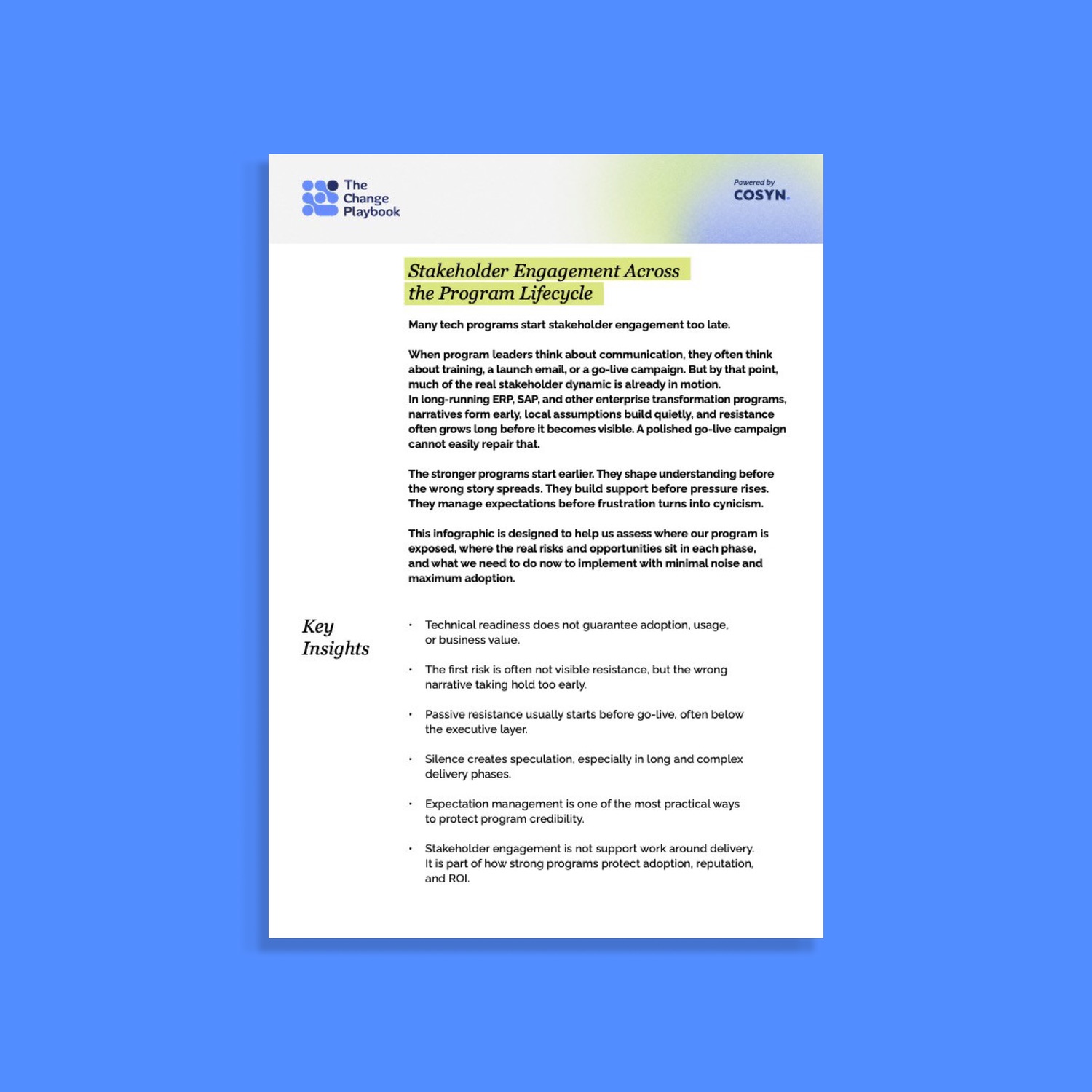
Engagement Across Program Lifecycle
A phase-by-phase diagnostic to spot your program's hidden exposure.
Download infographic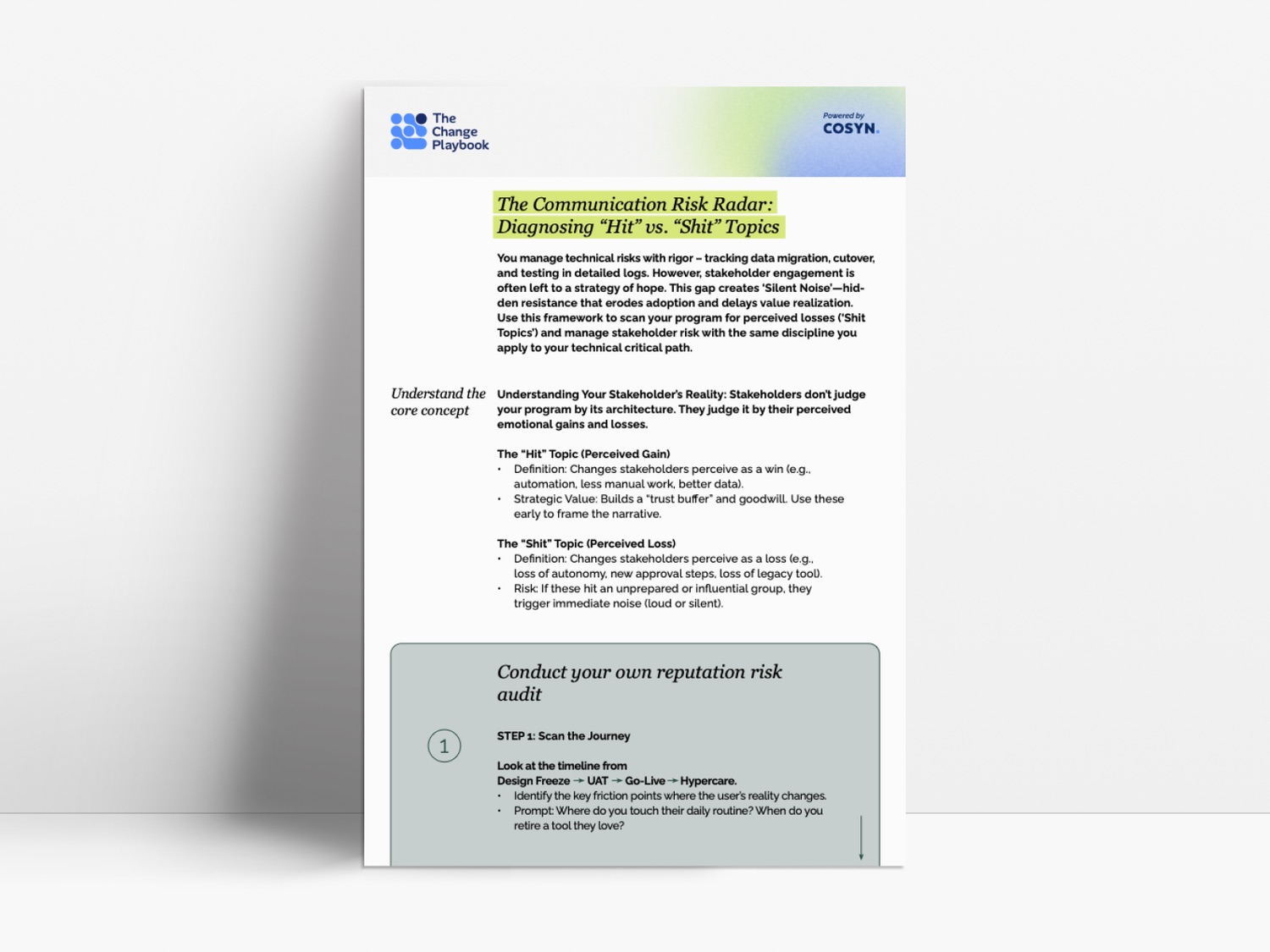
The Communication Risk Radar
Scan your program for the topics that create noise before they surface at go-live.
Download infographic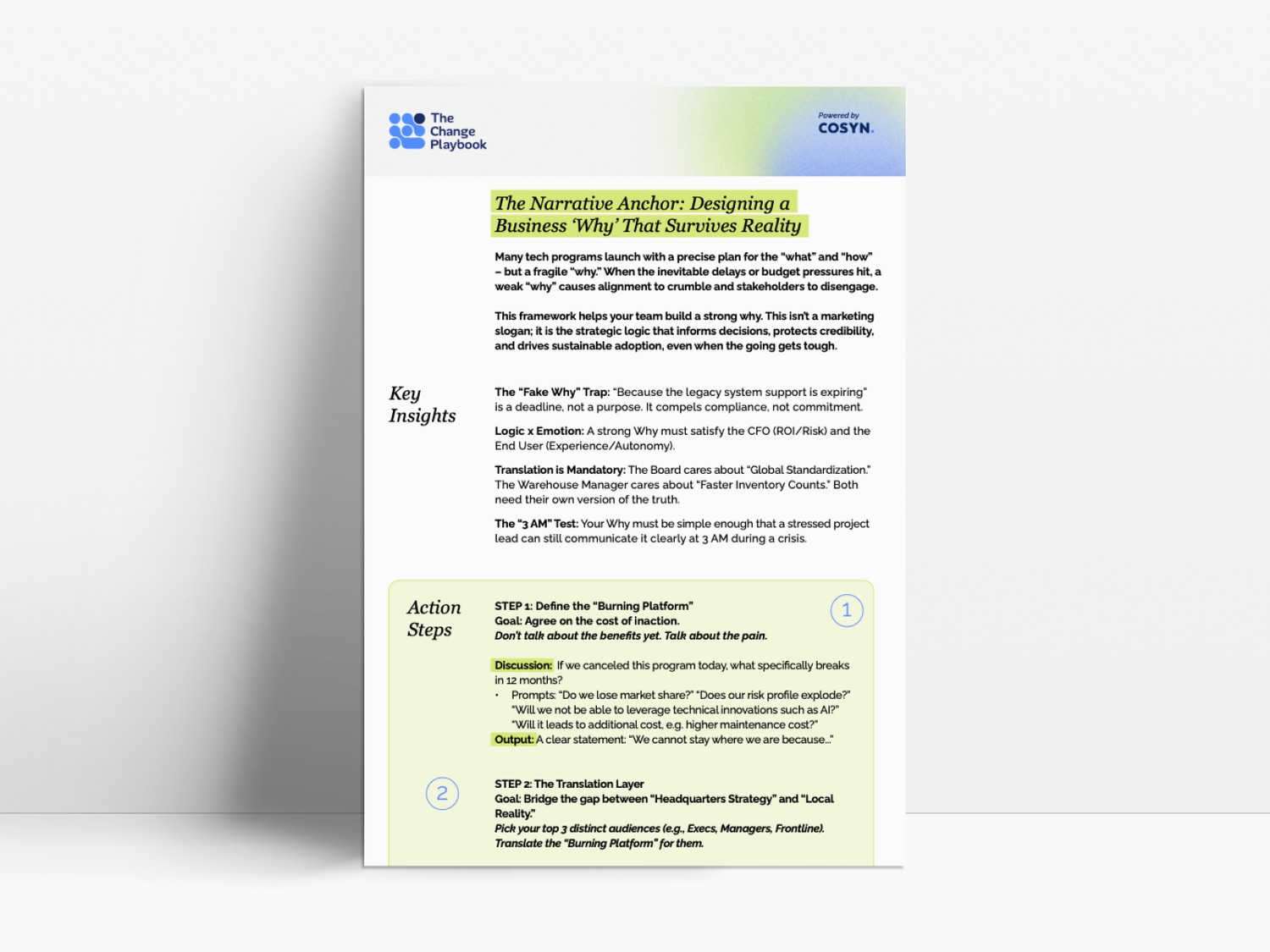
Building Your Why
A 4-step framework to build a 'why' that holds up under pressure.
Download playbook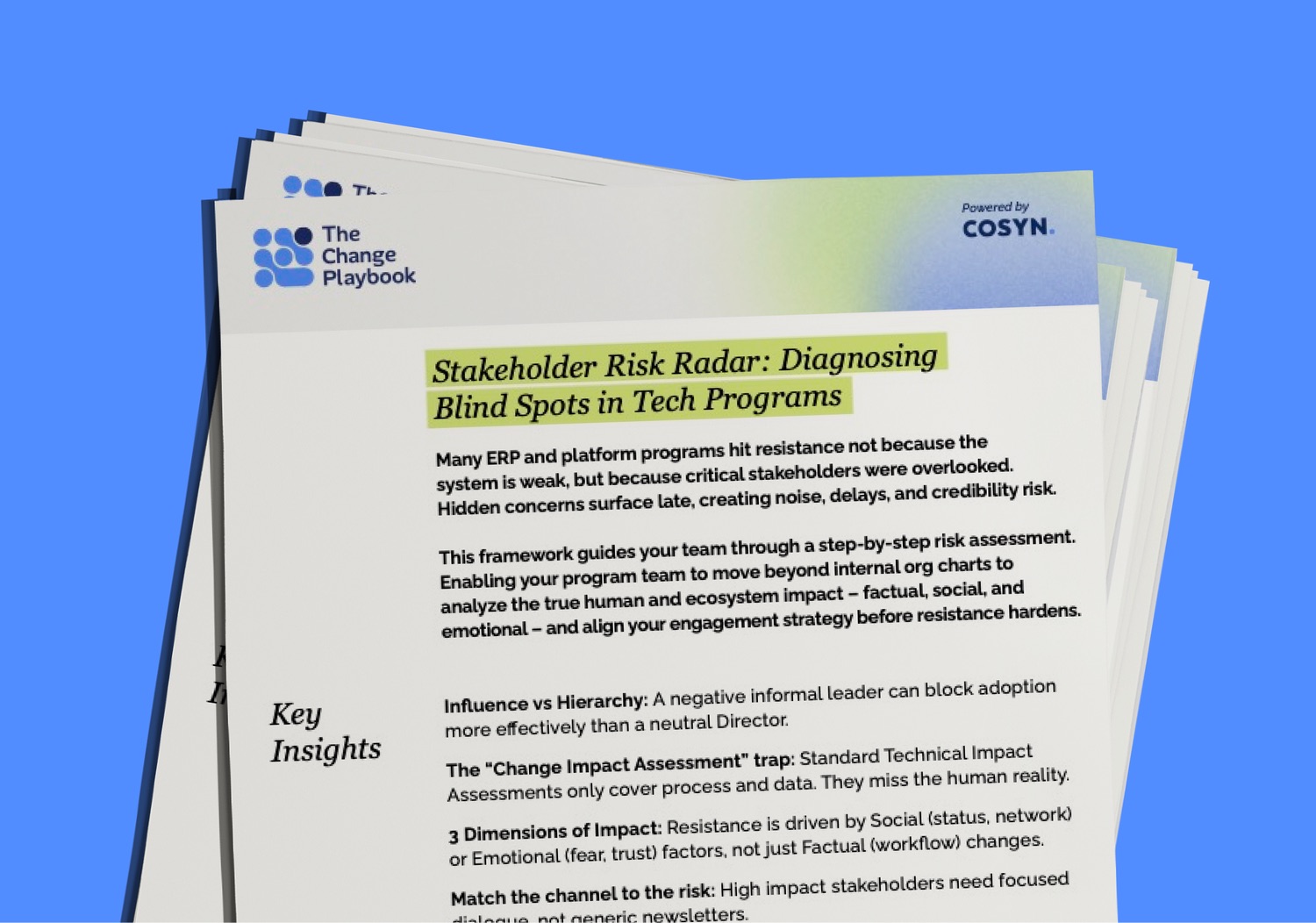
Stakeholder Risk Radar
A 3-step framework to identify who will resist your tech program before go-live.
Download playbook
SAP S/4HANA implementation
5 strategies to make your organisation fall in love with S/4HANA
Download whitepaper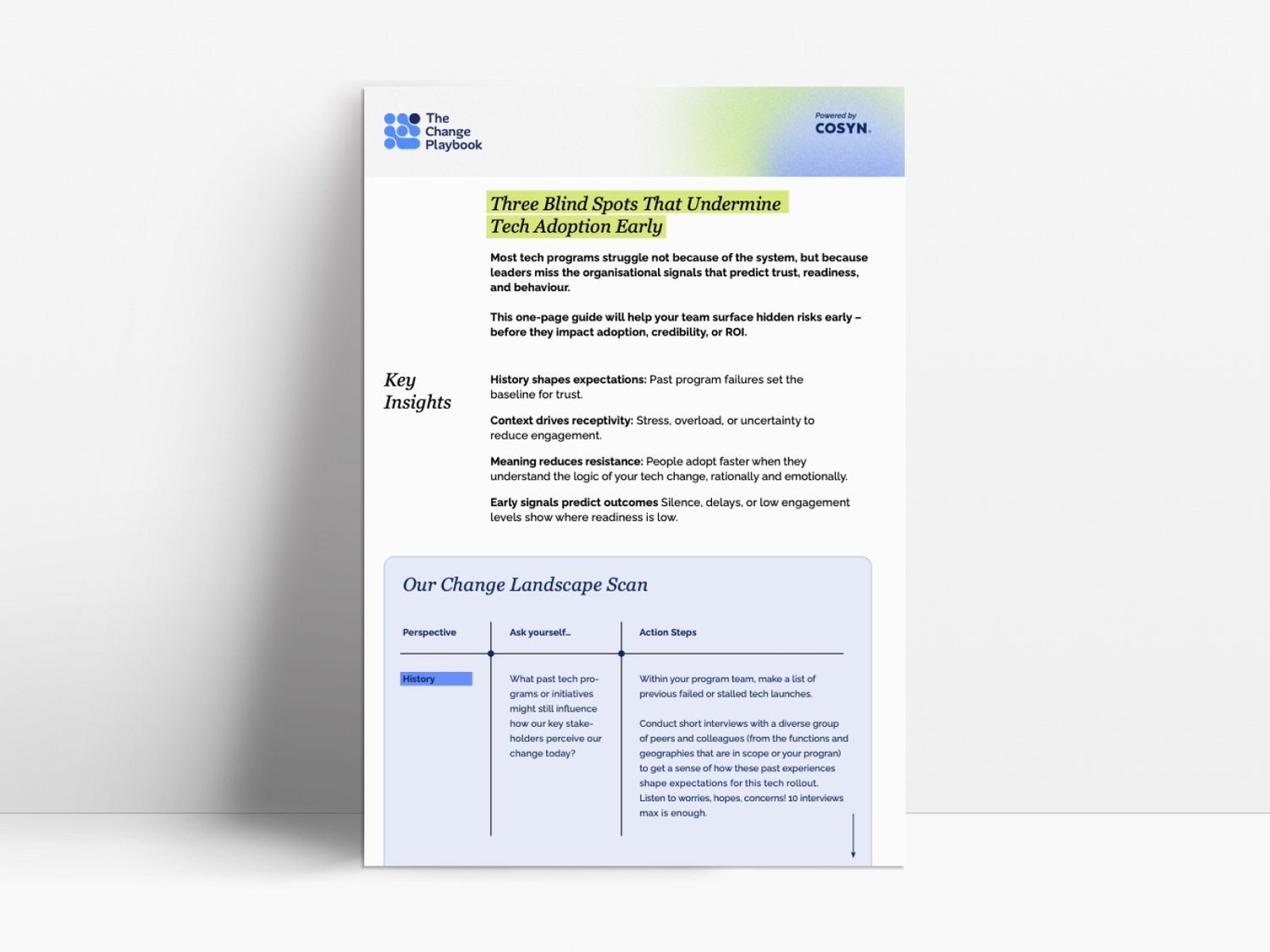
3 Blind Spots That Kill Adoption
How history, context, and meaning quietly shape adoption before go-live.
Download playbook
Happy Focused framework
Cut through information overload and turn stakeholder engagement into strategic impact.
Download whitepaper
Build an AI-ready culture
Embrace the unkown: How to build an AI-Ready culture?
Download whitepaperBlog
Episodes and articles
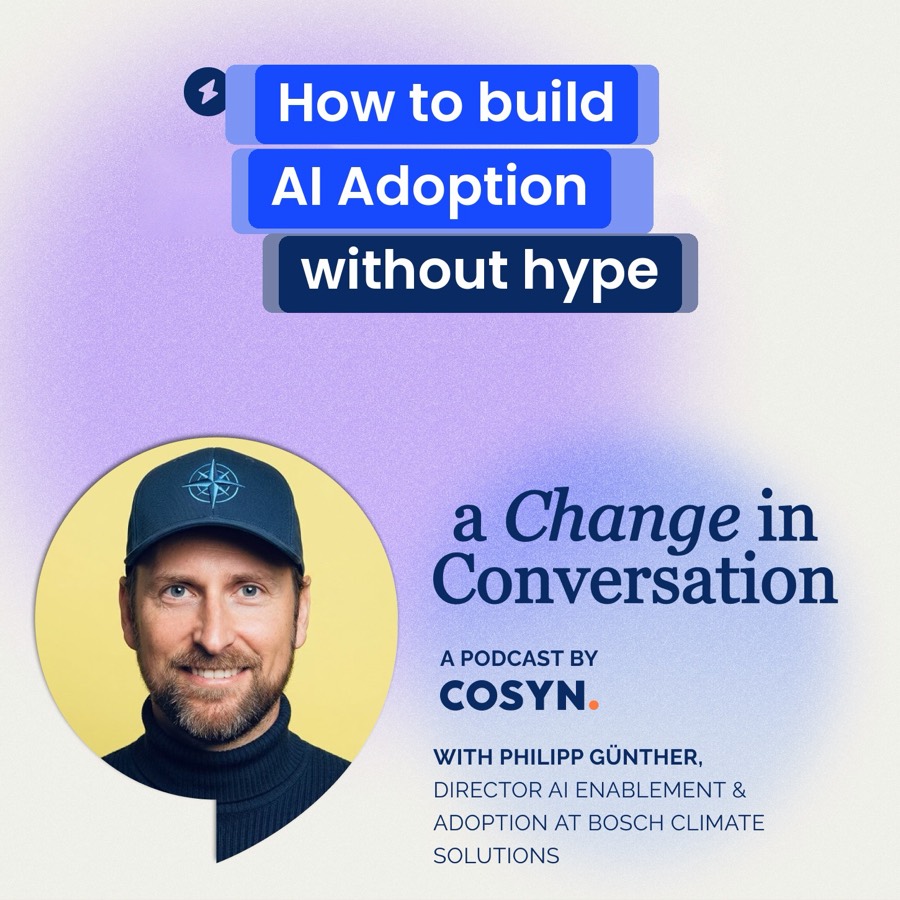
How to build AI adoption without hype | Philipp Günther (Bosch Climate Solutions)
In this episode, Bosch’s Philipp Günther makes a clear case: sustainable AI adoption is not solved by newer models. It depends on where leaders place attention, time, trust, and resources. We discuss how Bosch identifies high-value use cases, builds trusted ambassador networks, creates low-barrier formats for employees to experience AI in action, and assesses AI ROI. For the C-suite, the lesson is clear: broad adoption requires focus, ongoing mobilisation, and leaders willing to get their own hands dirty.
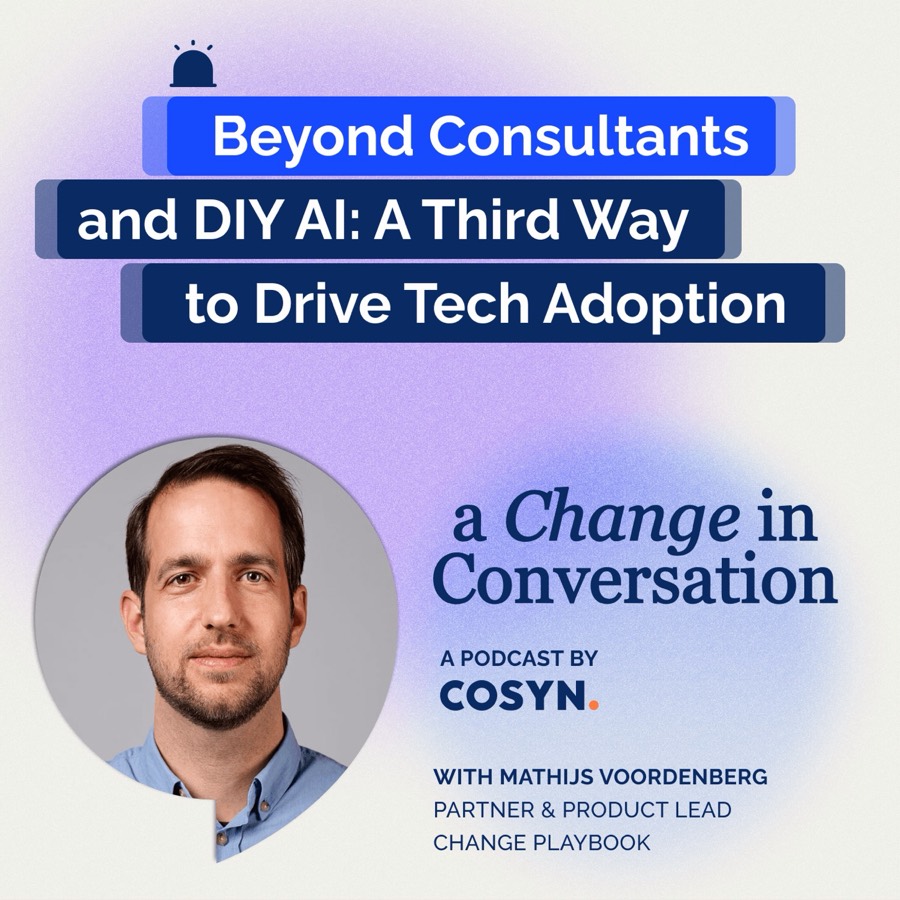
Beyond Consultants and DIY AI: A Third Way to Drive Tech Adoption
CIOs and Digital Transformation Leaders face intense pressure to deliver technology faster and cheaper. To drive adoption, leaders often choose between slow, expensive consultants or fast, context-blind AI. Both jeopardize your program's ROI. In this episode, Arne and Matthijs break down a smarter third way. Learn how to empower your internal teams to build an end-to-end adoption strategy in-house. Discover how software-augmented frameworks combine expert guidance with efficiency to secure lasting behavioral change.
4 things CIOs must get right to build influence
AI has put IT at the centre of business change. In this episode, we explore four things CIOs must get right to turn that moment into influence: strategic clarity, stakeholder trust, adoption, and value storytelling. The risk is clear: if IT remains seen as an operational provider, it may miss its chance to become the strategic guide the business now needs.
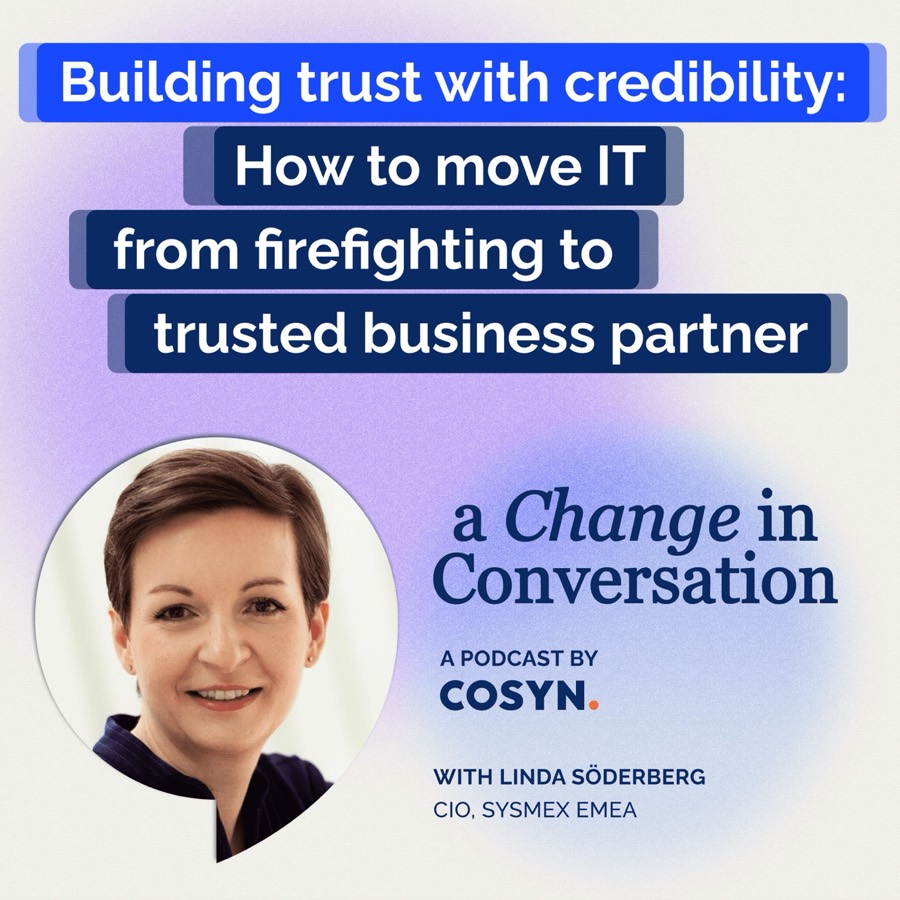
Building trust with credibility:How to move IT from firefighting to trusted business partner/Linda Söderberg (Sysmex)
Linda Söderberg shares how IT leaders can move from firefighting to trusted business partnership by reducing operational noise, creating focus, and rebuilding credibility with the business. She explains why strong IT leadership starts with stabilising operations, managing demand, setting clear priorities, and communicating with a customer-centric mindset. A practical episode for CIOs and IT leaders balancing steady-state operations with future growth, innovation, and rising business expectations.
Stakeholder buy-in at scale: How to mobilize 80 countries behind one SAP transformation | Jorge Lopez (Syngenta Group)
In this episode, Jorge Lopez explains how Syngenta Group led a global S/4HANA rollout across 80 countries by linking the program to business value, involving regions early and building a strong cross-functional team. He shares practical lessons on governance, stakeholder alignment, standardisation versus local needs, team energy, data readiness and trusted partner collaboration. Miss these foundations, and even technically sound transformations risk slower adoption, more resistance and a harder go-live.
When to start your stakeholder engagement
In this episode, we show why stakeholder engagement in tech change must start far earlier than most programs think. Using a typical ERP lifecycle as a blueprint, we break down how to build buy-in, surface hidden concerns, manage expectations, and protect program credibility across every phase. Start too late, and resistance, weak adoption, and ROI loss become much harder to contain.
The 4 forces behind tech adoption
Go-live is not adoption. In this episode, we break down the four forces that decide whether a new technology gets used – sustainable and compliant or quietly slides into workarounds: the technology, the individual, the social layer, and the wider system around the change. You’ll learn where resistance starts, why adoption drops after launch, and what leaders can do early to protect data quality, usage, and ROI.
Why recognition is the fuel that will power your team through the ERP marathon
ERP programs are marathons. When timelines stretch over years, the risk isn't just technical – it's team burnout. This episode reframes recognition from "soft HR" to a strategic lever for sustaining momentum. Learn to avoid the "Rush & Drop" trap, embed celebration into your operating rhythm, and empower Stream Leads and Local Project Leads as recognition multipliers. Discover why building a strong "immune system" protects your delivery capacity and prevents talent churn in complex, multi-year transformations.
How decentralizing comms can help to hedge local resistance
Global programs often fail when countries treat them as distant 'HQ initiatives,' leading to low acceptance and poor user adoption. This episode explores why localisation of stakeholder engagement is strategic risk mitigation, not just translation. Learn how to activate local multipliers, replace heavy toolkits with agile 'mini-briefings,' and scale engagement without overloading your central team. Discover the practical framework to turn global noise into local ownership and buy-in.
How to find the sweet spot of visibility for your IT program
Many IT programs struggle to secure stakeholder buy-in because they don’t get the right level of visibility – sharing too much, too early, or too late. Inside the organisation’s attention economy, your tech program competes with every other initiative for airtime and leadership focus. This episode shows how to find the right tone and timing and build momentum deliberately so your program cuts through the noise. Get practical guidance to ensure lasting user adoption and protect the reputation of your IT investment.
Discover the early-warning system every IT leader needs before go-live
Most tech programs fail not because the system is wrong, but because misalignment goes unnoticed until it’s too late. In this episode, Arne explains why structured, ongoing dialogue is your most reliable early-warning system when it comes to multi-year and multi-stakeholder tech transformation. You’ll learn how to surface hidden stakeholder risks, understand the rational resistance of line managers, and combine qualitative and quantitative insights to react fast and targeted and hence avoid reactive “reputation firefighting”. Practical guidance for IT leaders who want fewer surprises and a stronger path to go-live.
The art of positioning your change to deliver buy-in, not resistance
Most tech programs unintentionally damage adoption by either overselling benefits or underselling the purpose. Overpromising creates disappointment when users experience turbulence at go-live; underselling makes the program invisible in a crowded internal environment. This article breaks down why expectations drive stakeholder behaviour, how to assess your true change impact, and how to set a narrative that protects adoption and ROI. You’ll learn a practical way to position your program with credibility — without noise, hype, or generic vendor messaging.
Five Comms Strategies to Guarantee Your Most Successful ERP Launch Ever
ERP outcomes vary widely between organisations using the exact same technology. The difference is not the system — it’s the human dynamics underneath the change. Legacy attachment, local power, team energy, cognitive overload and expectation gaps shape testing quality, data discipline, alignment and adoption. This episode explains why these forces matter, why leaders often underestimate them, and how early attention to human dynamics protects both your programme and your ROI.
The school of stakeholder engagement for IT leaders
Technical readiness does not equal user readiness. In this inaugural episode of “A change in conversation”, we explore why ignoring stakeholder dynamics leads to expensive shelfware, cost overruns, and reputational damage for program leaders. We outline how to shift from "change management theatre" to engineered adoption that secures your investment, moving beyond the technical "go-live" to ensure actual business value is realized.
How the ghosts of project past shape adoption before you even start
Many programs struggle with stakeholder buy-in not because the technology is weak, but because past failures shape how people respond before rollout even begins. In this episode, we break down the three patterns of “change heritage” that trigger early resistance, reduce engagement, and erode trust. You’ll learn how to diagnose initiative fatigue, burned terminology, and trust debt—and how to address them early to protect adoption, credibility, and ROI in your current program.
Why your Why is everything
Many tech programs have a solid plan for the “what” and “how” — but a weak or missing “why”. This episode explains why a clear business ‘why’ isn’t a nice-to-have but a practical requirement for alignment, momentum, and stakeholder commitment in long programs like SAP or ERP. You’ll learn what makes a strong why, what happens when it’s missing, common pitfalls, and concrete steps to build a message that holds support when challenges hit.
Why understanding your stakeholder is the key to fixing tech resistance
In this episode, we break down why superficial stakeholder analysis creates avoidable surprises, noise, and late-stage resistance in tech programs. You’ll learn the two common failures teams overlook, and a practical three-step approach to spotting hidden concerns early. We show how to map the full stakeholder ecosystem, assess impact with clarity, and profile critical groups so you can prevent resistance before it escalates and protect the brand of your program.
The three common blind spots that could derail your ERP comms strategy
Even well-structured programs face adoption risk when leaders treat each rollout as a fresh start. Employees don’t. They carry the memory of previous failures, current stress levels, and unclear strategic narratives into every new initiative. This article breaks down three common blind spots—history, context, and strategic alignment—that consistently undermine ROI, regardless of platform or sector. If you recognise these patterns early, you protect adoption, reduce stakeholder risk, and spare your program from preventable credibility damage.
Mind the gap:How to spot comms risks before they drive resistance
Tech programs rigorously track technical risks but often ignore the "silent noise" of stakeholder resistance until it erodes adoption. This episode introduces the "Hit vs. Shit" lens—a practical framework to diagnose communication gaps before they escalate. Learn to map your rollout’s perceived gains and losses, score adoption risks like technical logs, and protect your program’s reputation. Stop reacting to noise and start managing stakeholder risk with the same rigor as data migration.
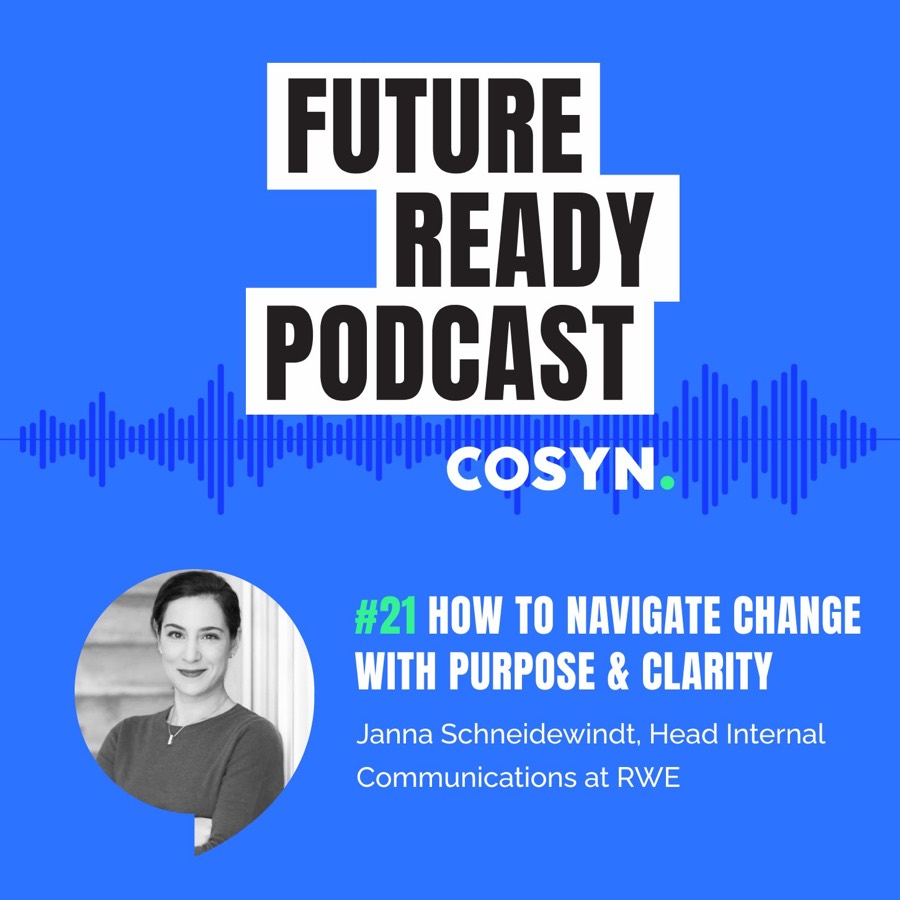
How to Navigate Change with Purpose & Clarity
With Janna Schneidewindt, Head Internal Communications at RWE.
Why should true leaders embrace the unknown?
This is the question we put to Dr Nick Udall, founder and CEO of the nowhere group.
The Science of Uncertainty (And How to Use it)
“The future is uncertain, but this uncertainty is at the very heart of human creativity.” ~ Ilya Prigogine, Belgian Chemist and Nobel Prize winner (1977).

The Beauty of Ambiguity: What Comms Can Learn From Science
As communicators it is deeply embedded within us to bring clarity to situations, to avoid ambiguity, to leave no room for doubt. But is that always possible? And if not, how can we deal with it?
The Key to Building AI-Ready Cultures
The topic of AI is developing at such a speed that even the experts do not dare predict how it will go. Whilst boardrooms are still trying to wrap their heads around what this means for the business and operating model, advances in Generative AI have brought the AI experience literally into the hands and on to the desks of each employee in the form of ChatGPT, Co-Pilot or other native solutions.

True beauty lies within…
Opinion: Mathijs Voordenberg, Managing Partner at COSYN.
Why Employee Feedback is not (always) the answer
Employee engagement surveys have long been a staple for organizations seeking to gauge workplace satisfaction and identify areas for improvement. But are they always useful? We’ve seen a move away from the large-scale annual surveys towards more pulse-type surveys, which can definitely offer a better, and more regular, insight. However, still relying solely on these self-reported feedback mechanisms can paint an incomplete picture. Behavioural science research suggests that observing employee behaviour is a far more reliable indicator of their true sentiments and engagement levels.
Are you ready for Radical Honesty?
Have you come across the concept of radical honesty before? Starting out as the title of a book by controversial self-improvement author Brad Blanton, in recent years the idea has spread and evolved. In short, to be radically honest means telling the absolute truth, without even resorting to so-called white (non-harmful) lies. On a personal level it is argued that radical honesty allows people to become completely authentic, to share their real thoughts, ideas and experiences rather than attempting to say what others want to hear. But what about within organizations? Is there are argument for employing radical honesty there? And what about if we apply the idea to internal comms too? We think it’s an idea worth exploring.
Why your employees' ears might just be the way to their heart
Once upon a time video killed the radio star, but in recent years our fondness for all things audio has resurfaced. From podcasts to audiobooks and from Siri to voice notes, we have seemingly rediscovered the power of the voice in communications. To give you some idea of the scale of the consumption in audio content, data suggests that 131 million Americans are listening to audio content daily, while it's forecasted that there will be around 160 million podcast listeners in the US by 2026.
How to activate teams and keep them engaged?
With dr. Eleni Georganta, assistant professor in Work and Organizational Psychology at the University of Amsterdam.
How to introduce the new AI colleague?
With dr. Eleni Georganta, assistant professor of Work and Organisational Psychology at the University of Amsterdam.
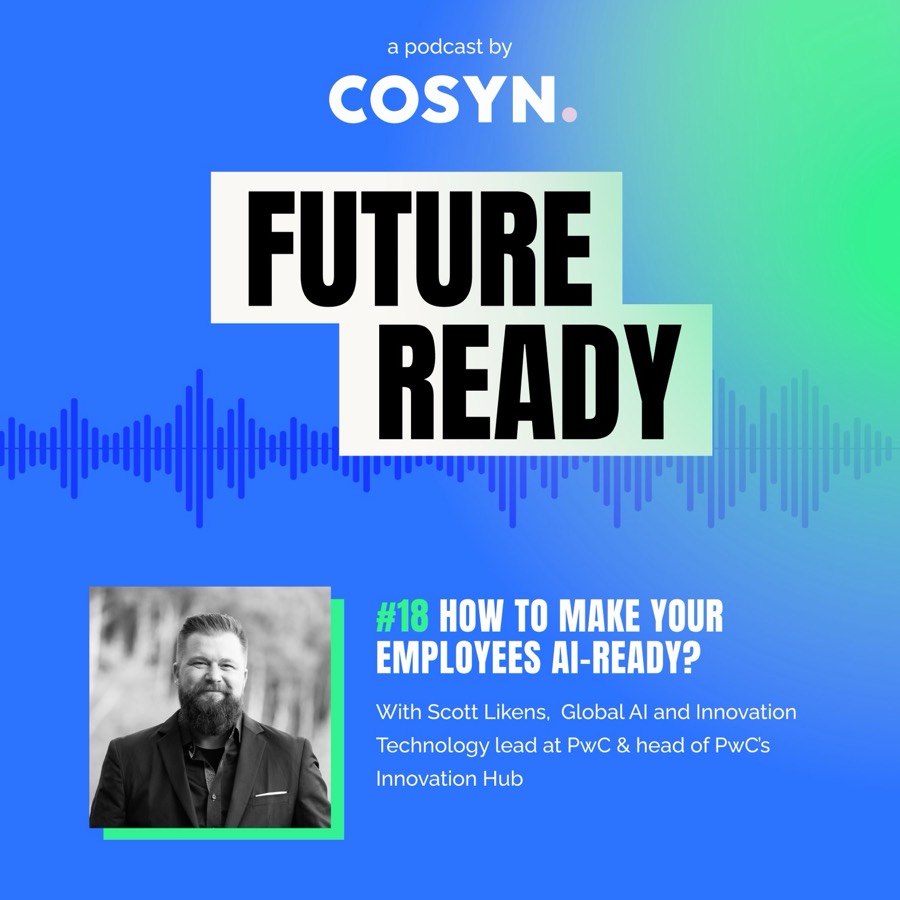
How to make your employees AI-ready?
With Scott Likens, Global AI and Innovation Technology lead at PwC & head of PwC’s Innovation Hub.
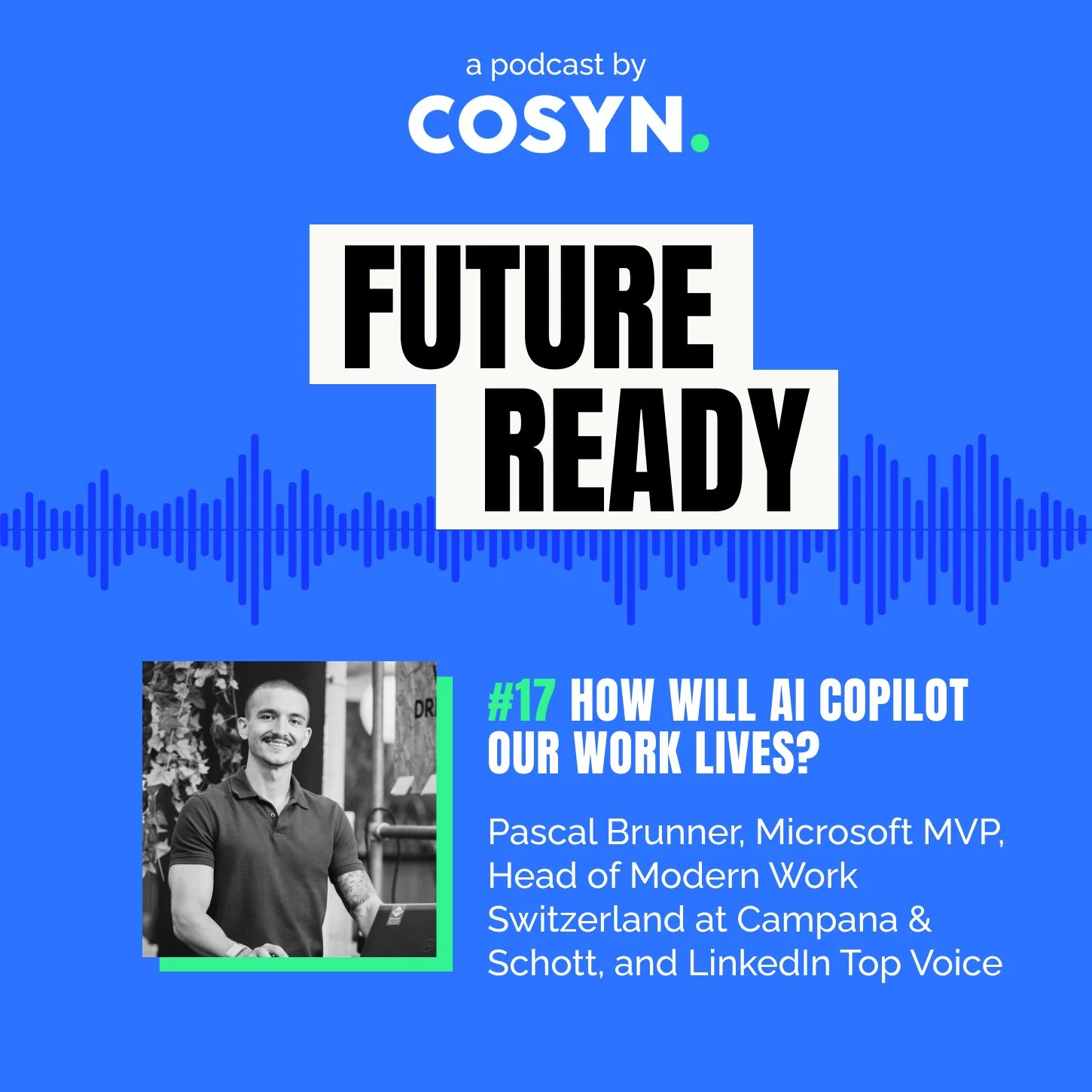
How will AI copilot our work lives?
With Pascal Brunner, Microsoft MVP, Head of Modern Work Switzerland at Campana & Schott, and LinkedIn Top Voice.
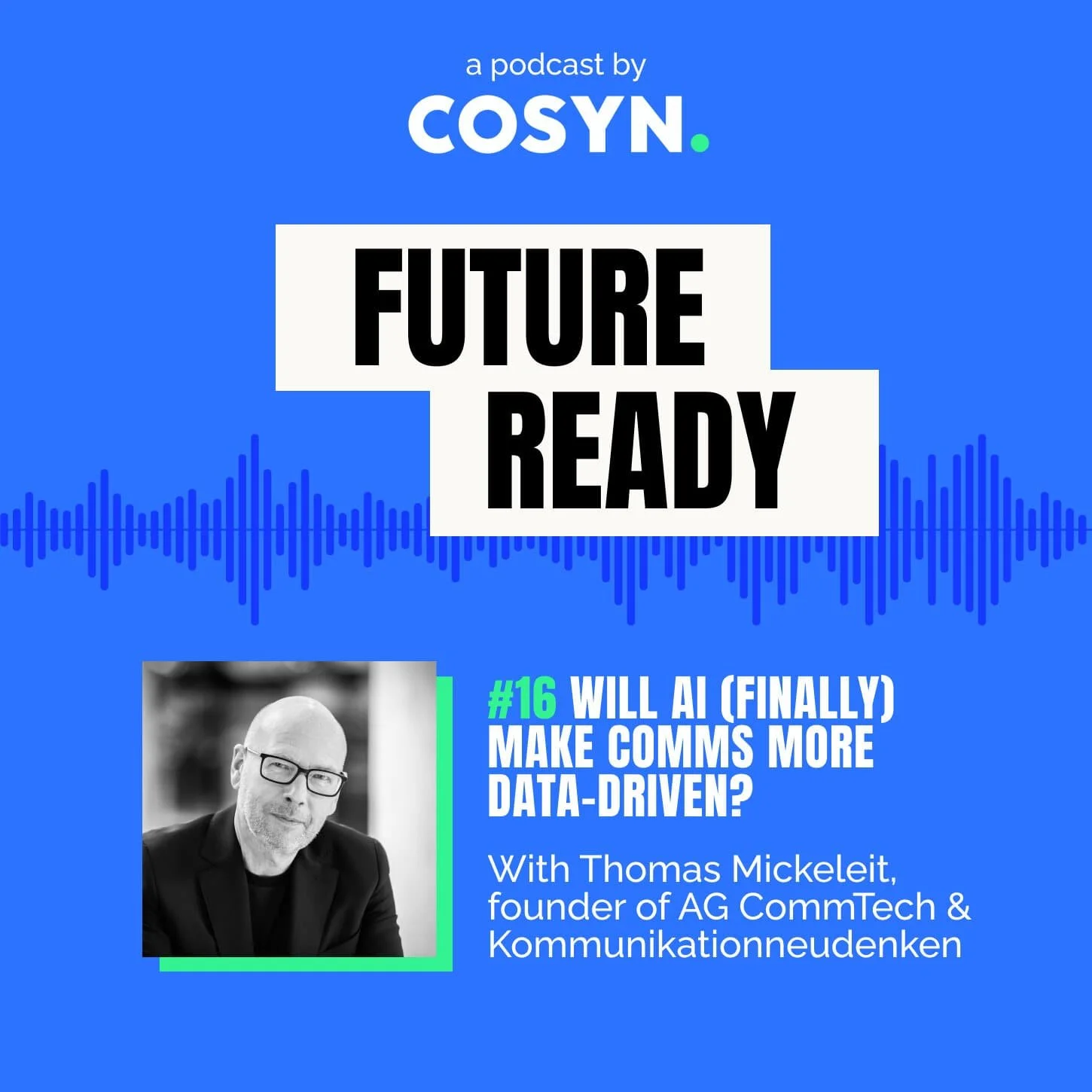
Will AI (finally) make comms more data-driven?
With Thomas Mickeleit, founder of AG CommTech and Kommunikationneudenken.
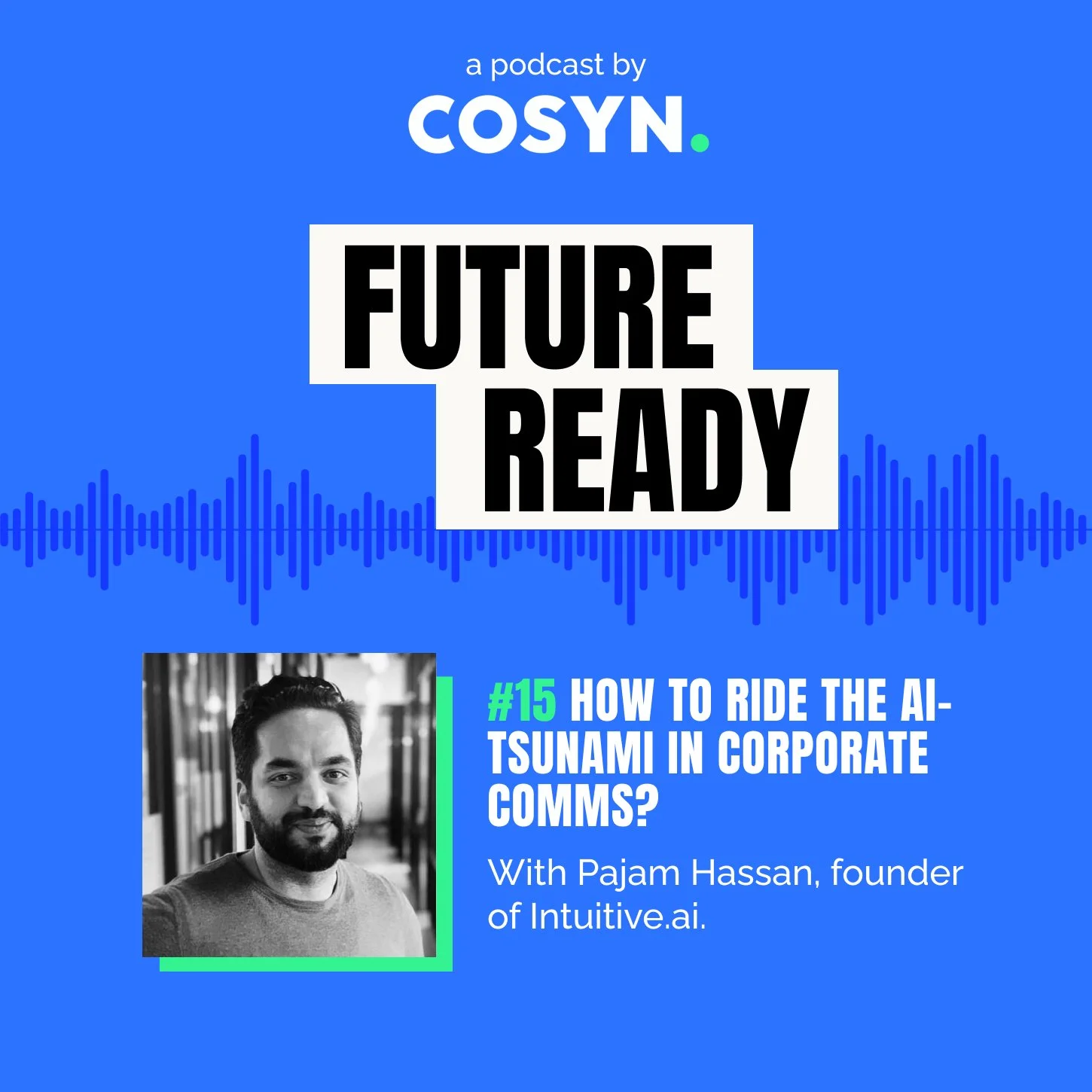
How to ride the AI-tsunami in corporate comms?
With Pajam Hassan. CEO and founder of Intuitive.ai.

Employee Engagement vs Employee Satisfaction: What's the Difference?
Employee engagement has become quite the buzzword in recent years – and with good reason. It's the secret ingredient that transforms an average workplace into a thriving one. Survey guru Gallup has shared previously that companies with highly engaged employees enjoy on average 81% less absenteeism, 18% higher productivity and a whopping 23% higher profitability.
How can neuroscience help us catalyse sustainable change?
With Dr. Brandi Shaw Morris, Assistant Professor at Aarhus University.

Everything* we’ve learned from the frontlines of internal communications strategy
actually there’s a lot more, but this is just a blog post so in the interest of brevity we’ve had to make substantial edits.

The 4 E’s of Employee Engagement (and why they are EVERYTHING)
As we already know, engaged employees are the driving force behind a successful and thriving organisation. But what exactly does it take to create an environment that fosters engagement? Where your people are excited to do what they do, collaborate with other and drive the success of the business. Allow us to introduce the 4 E's of employee engagement: Energy, Empowerment, Enablement, and Encouragement. Together, these four powerful pillars are the foundation of any successful engagement strategy. Let’s explore them in more detail…

Getting the measure of employee engagement: How happy ARE your people?
When it comes to understanding the impact of your employee engagement activities, you clearly need to go on more than just ‘vibes’. If you’ve put a structure in place around internal communications and employee engagement, then you have hopefully already outlined a number of SMART metrics or KPIs which will help to provide some insight into how well it’s going.
How to lead in the unknown?
With Dr. Nick Udall, CEO & co-founder of the Nowhere Group
How to build anti-fragile organisations in the 'new normal'?
With Dr. Lucia Garcia Lorenzo, Associate Professor for Organizational and Social Psychology at the London School of Economics (LSE).

The employee engagement models you need to know about
Maybe the first place to start is defining exactly what we mean by an employee engagement model. In short, it describes a structure or framework around which organisations can begin to understand, measure and improve the engagement of their employees. They vary from high level concepts to practical applications of tools but often have a lot of the same ideas running through them. As they say, there are many ways to crack an egg, and it’s no different when it comes to cracking the code of employee engagement. So, let’s look at some of the models available (this is a small sample!), and find some inspiration when it comes to designing your own employee engagement strategy!
How to design a unique employee experience?
With Magali Demierre, Global Head of Employee Experience at Philip Morris International (PMI).
How to change with behavioural science?
With Antoine Ferrere, Global Head of Behavioral and Data Science at Novartis.
Can companies suffer trauma?
Prof. Dr. George Bonanno, Chair of the Department of Counseling and Clinical Psychology, and Director of the Loss, Trauma and Emotion Lab at Teachers College at New York’s Columbia University.
Tell us about a change you need to land
A rollout coming up, an AI programme that stalls, or a go-live that did not stick. Tell us where you are, and we will tell you honestly where we think it could stall and whether we are the right people to help.
- Where your change is most likely to stall
- Which first step would make sense, if any
- What a first plan could look like
No cost, no commitment, no sales deck afterwards.